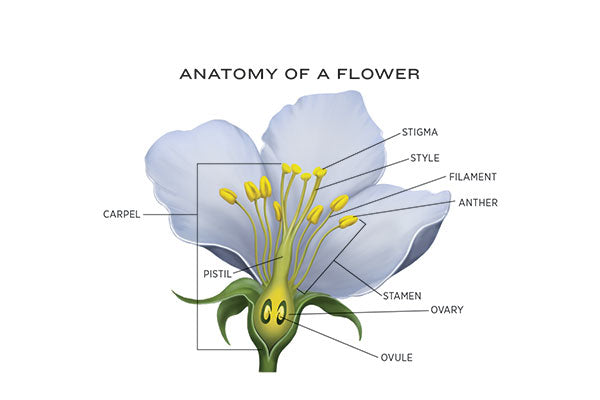
Honey Bees Communicate Through Movement Dance Language Honey bee workers perform a series of movements often referred to as the waggle dance to teach other workers the location of food sources more than 150 meters from the hive. The stamen is the male part of a flower.

Parts Of The Flower Where Bees Need To Collect And Deposit Pollen For Download Scientific Diagram
Plants have therefore evolved different morphological structures and floral cues to narrow the spectrum of pollen feeding visitors.

. In a flower diagram stamen are located on both sides of the pistil. This is a bright-coloured part that attracts bees insects and birds. Some bees have even developed basketlike structures on their hind legs that allow them to carry pollen.
For reproduction to take place the pollen must land on the flowers female structure the stigma of the pistil. Up to 24 cash back Explain how plants respond to a light source usually the Sun. Nanoscale patterns on the petals reflect light in a way that effectively creates a blue halo around the flower that helps attract the bees and encourages pollination.
Other flower features may attract or repel certain bees. The filament is the stalk attached to the flower that holds the anther. When bees go from flower to flower collecting pollen they are also depositing pollen grains onto the flowers thus pollinating them.
When a bee buzzes from flower to flower of the same species grains of pollen are transferred to a flowers stigma pollinating the plant. Their inch-long bodies hold at most a few million neurons. Biology is brought to you with support from the Amgen Foundation.
Honey Bee Dance Language. Parts of a Flower. What is occurring inside the.
The aroma of the nectar attracts the bees. In a real environment where red flowers would be more camouflaged against the different shades and intensities of the green foliage the ability of bees to discriminate red. Scout bees fly from the colony in search of pollen and nectar.
While pollen and nectar in most cases are the most notable reward attained from flowers bees also visit flowers for other resources such as oil fragrance resin and even waxes. Moving flower to flower the bees are transferring pollen to the stigma female part of the flower. Among filtering mechanisms the chemical and mechanical protection of pollen might shape bee-flower interactions and restrict pollen exploitation to a specific suite of visitors such as observed in Asteraceae.
Some are bright while some are pale coloured. French visual scientist Dr. Plant-pollinator mutualisms are particularly important and involve nearly 170000 plant and 200000 animal species.
Mutualistic interactions are mutually beneficial species interactions. When the bees fly to another plant of the same species they may fertilize. The vegetative part of a flower consists of the following.
The different parts of a flower are mentioned below. Yet with such meager mental machinery honeybees sustain one of the most intricate and explicit languages in the animal kingdom. The stamen consists of two parts.
At the tips of the stamens are the anthers where pollen is produced. Interpret the links between pollination and food production. The diagram below outline how the bees facilitate the process of pollination.
One pair of gonapophyses of segment 9 fuse together to form a single stylet sheath the other pair form two stylet palps. As bees collect nectar pollen from the anther male part sticks to their body. Some bees including honey bees revile excessively large pollen grains such as those produced by hibiscus although they like the nectar.
The reason is that this most of all the senses like sight makes us know and brings to light many differences between things. When the worker bee is busy collecting nectar and pollen some of the pollen will stick to their hair. Vegetative Parts of a Flower.
Identify the plant parts involved in reproduction identify the animal bee structures involved in pollination and demonstrate how pollen moves from the male stamen to the female stigma. Describe the complementary relationships between pollinators and. Colour of petals varies from plant to plant.
Most flowers have taken advantage of this and have ultraviolet patches called nectar guides. Because of the structure of their visual system bees trained to feed at artificial red flowers take longer to find their goals than bees trained to feed at other-coloured flowers Spaethe et al. The sting is made of 3 pairs of gonapophyses one pair of segment 8 and two pairs of segment 9.
Bees see flowers differently than humans. The anther is the head of the stamen. Some honey or nectar is regurgitated from the honey stomach and mixed with the pollen grains in order to help them stick together.
To germinate these plants require the transfer of pollen from the male part of the flower the anther to the female part the stigma. In the darkness of the hive bees manage to communicate the precise direction and distance of a newfound food. At the next flower some of this pollen will rub into the stigma of that flower.
The worker bee has a special nectar sac within the stomach called a crop. These guides help attract bees to land and show the bees where to get nectar. In many interactions between bee pollinators and plants bees collect the nectar from the reproductive parts of the plant and are often dusted with pollen in the process.
Bees have branched hairs that pick up pollen while they are feeding. As bees move from flower to flower in search of nectar they leave behind grains of pollen on the sticky surface allowing plants to grow and produce food. Some bee species even have special pollen baskets where they carry the pollen.
Image by Plantsurfer via Wikimedia Commons. If successful in finding good supplies of food the scouts. They can carry as much nectar in this as their own body weight.
Yet those humongous sticky treats are adored by others such as the hibiscus turret bee Ptilothrix bombiformis. As the bee visits a flower pollen catches on the tiny hairs covering its body. The gonapophyses of segment 8 form two stylets lying parallel and enclosing a poison-canal.
The stamens function is to produce male reproductive. They can see visible light and also ultraviolet UV light. This pollinates the plant.
Once the bees body is covered with fine pollen grains the bees will use stiff hair-like structures on her legs to groom themselves and comb all the pollen off their body. Louis Brassard agrees but goes. Explain how different flower structures might interact with a bee for example to help the plant.
Simpsons index of diversity. Honeybees dont have much in the way of brains.

A Symbiotic Relationship Flowers Bees Edn
A Symbiotic Relationship Flowers Bees Edn
Bees Can Sense The Electric Fields Of Flowers



0 Comments